
👋 Hey. Welcome to issue #179 of The Everyday Athlete Newsletter.
Here are my 3 favourite ideas, learns and resources to help you improve your performance this week (4 min read):
🏃 The mindset that works in sport destroys your health in real life

Professional sport requires peak performance.
Real life requires reliable performance.
This was one of my biggest lessons transitioning out of professional sport.
See, pro sport is about being at your best. In this time. At this place. Go.
But in real life, there's no matchday. No tunnels. No crowds. No 110kg Fijians running straight at you (except in nightmares).
It's a different game:
- 🏁 Sport is a finite game with clear rules and a clear end
- 🤹 Real life is an infinite game with changing rules, moving pieces and no finish line
But we still approach health like it’s a finite game.
Like there’s a finish line.
I did...
I followed the typical ex-rugby player arc:
Marathon.
Perfect. Another finish line to chase.
And that’s how so many busy parents and professionals treat their health too.
Short sprints.
Max effort weeks.
All-in or nothing.
Black and white.
And we get away with it in our 20s.
But after 30, it means we swing between intensity and burnout. And blame discipline when we can't sustai it.
But it’s not a lack of discipline. It’s that the game plan that once worked no longer fits the life you’re living.
Because the goal isn’t to get healthy.
It’s to stay healthy.
And so I had to learn it was no longer about winning.
It was about finding joy in progress.
Finding joy in how my habits made me feel.
How they let me show up as a better human.
(which I know sounds fluffy. but it's just f*ing true)
And to do that, a new approach is required.
One that works:
- 🥱 under poor sleep
- ✈️ during travel
- 🧑🍼 while parenting
- 😥 during stress spikes
- 💼 with work deadlines
Because an approach that relies on peak performance won't survive an infinite game.
So find your reliable performance approach.
And keep playing.
--
p.s. if you want a strategy that keeps your training, nutrition, and habits alive when life doesn’t go to plan (because she never does), I made a short guide:
🔗 How to stay in motion when life gets hectic
Hope it's helpful.
🏃 A blind spot in my training routine
Brady Holmer fed his book ‘VO2 Max Essentials’ into NotebookLLM and it created this infographic.
Quality summary.
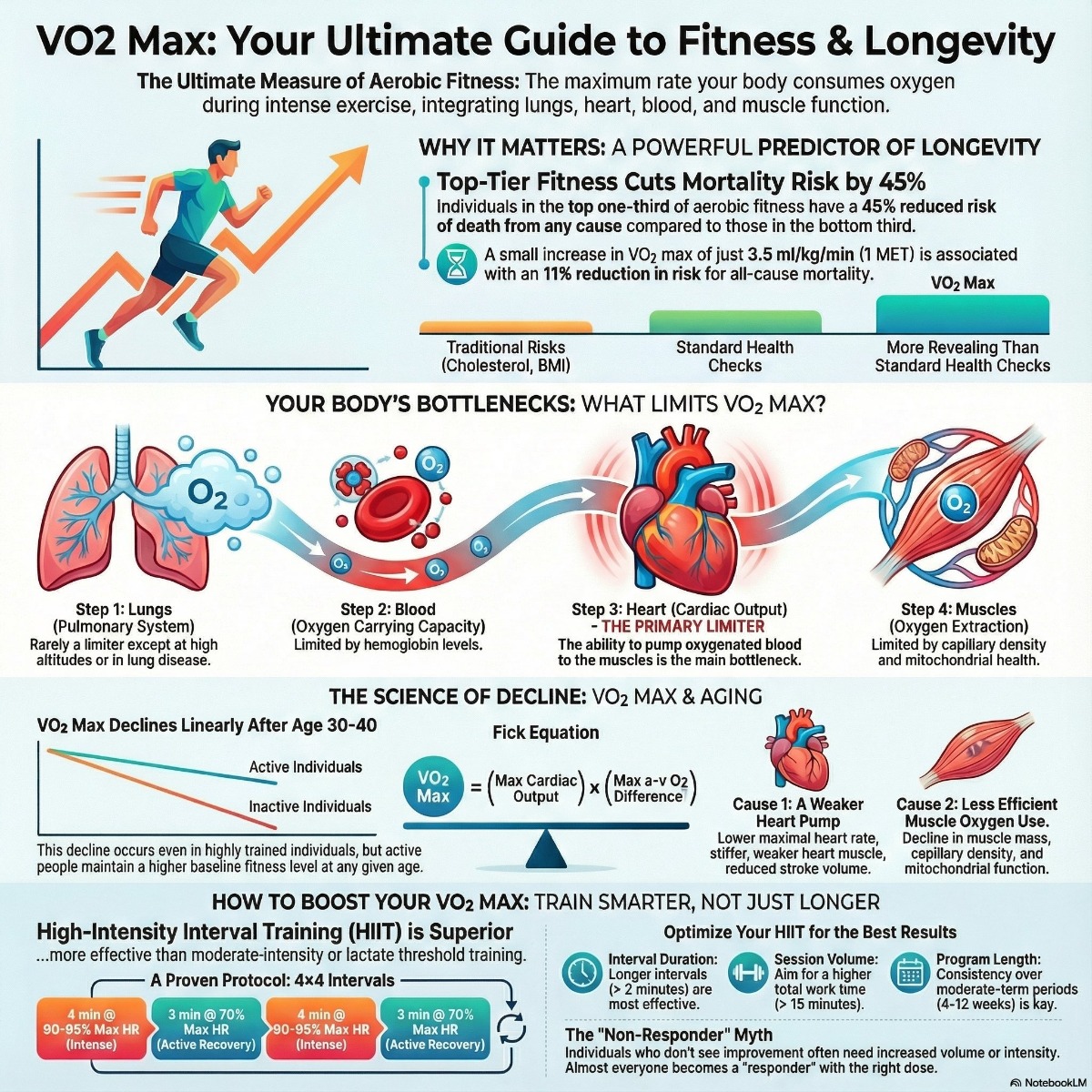
And great reminder for me to include some longer intervals.
💦 The stress–hydration relationship
Stress isn’t just psychological.
It’s physiological.
Tools help. Mindset helps.
But our bodies set the baseline.
The research below is a great example.
And it starts with a hormone called vasopressin...
Vasopressin is a hormone our bodies use to hold onto water.
It gets released when we're dehydrated.
It's almost like a "resource-saving mode".
Helpful little trick evolution has given us.
The drama is if we habitually don't drink enough water.
Because when vasopressin stays high for weeks/months, it signals the brain to release more stress hormones.
So when stress hits, our cortisol response is bigger and sharper.
So:
Low hydration → high vasopressin → makes us more sensitive to stress
This study showed how hydration status determines how the body handles stress.
- 🏜️ Low habitual fluid intake (~1-1.5L/day) cranks up cortisol when stress shows up
- 💦 Higher habitual fluid intake (~3-5.5L/day) buffers stress response
Interestingly, it also showed this stress relationship was less about the exact litres per day...
And more about urine colour.
(optimal = 1-3 in chart below)
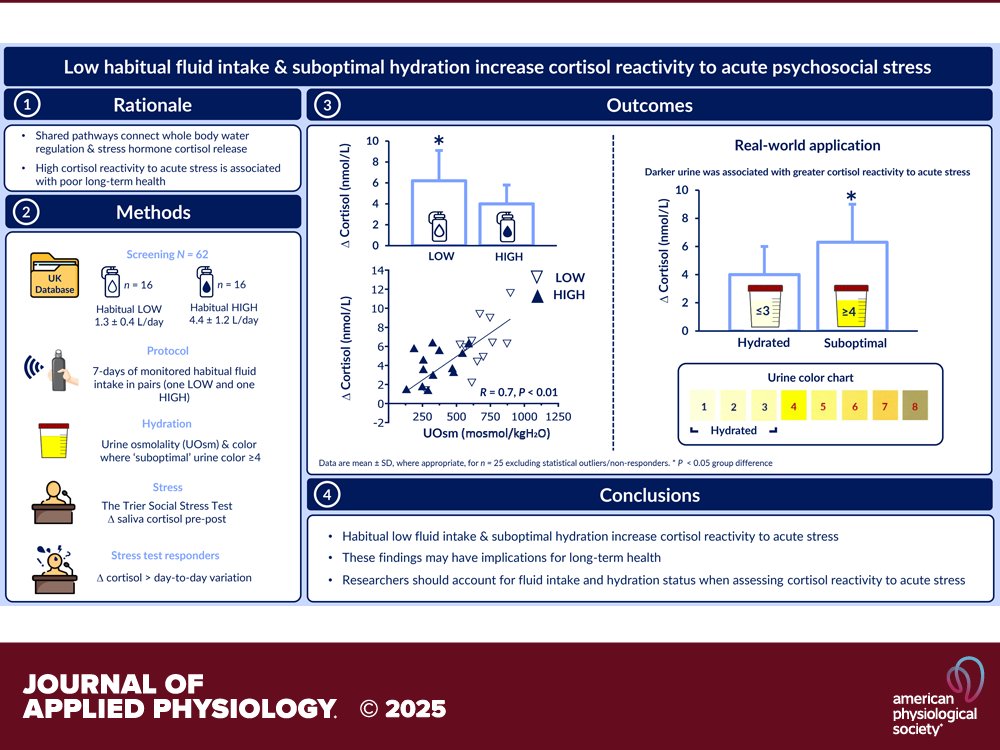
So turns out the old primary school urine colour chart has it pretty dialled in.
But note: we also don't wanna be peeing ultra clear.
Cause then we could be flushing out the electrolytes and minerals we need to function. And additionally replace what you lose i.e. if you don't eat much processed gear, salt your food.
So drink your water.
That's it!
Have a great weekend 🤙
Matt
📬 Did someone forward this to you? I send an email like this every week. Join free here.
👇 If these emails aren't for you anymore you can unsubscribe below. No stress, they're not for everyone.
The Everyday Athlete Newsletter is not a licensed health service nor a substitute for professional health advice, treatment or assessment. The information shared in this email is general and written for a specific audience. If you’re struggling, please see a healthcare professional.
0 comments