
👋 Hey. Welcome to issue #136 of The Everyday Athlete Newsletter.
Here are my 3 favourite ideas, learns and resources to help you improve your performance this week (4 min read):
🧠 A woman’s guide to Alzheimer’s

Louisa Nicola is an Aussie neurosurgeon and Alzheimer's disease researcher.
She’s started releasing episodes in a 10-part series called:
A woman’s guide to Alzheimer’s (ep. 1 here).
My biggest takeaway from the first two eps is that lifestyle and environment play a bigger role in determining risk of the disease than I thought (rather than just genetics).
Though her claim that 95% of cases are preventable is massively overstated – she says 1-3% of cases are caused by genetics that guarantee the disease (early onset Alzheimer’s), and then says that "for the other 99% of the cases, genetics interact with lifestyle, environment, and metabolic health." She then makes the leap from "not purely genetic" to "lifestyle-driven" without any evidence. Anyway, I’m getting sidetracked…
Because even still, the latest research suggests maybe even 45% of cases are caused by lifestyle and environment (i.e. our health behaviours).
So we're not sitting ducks.
We have more control than we think.
Now in 2025, there are ways we can identify our risk. Which, I – if high-risk – would invest more time, money and energy into prevention strategies.
Given dementia is on both sides of the family tree, testing for my genetic risk is something I plan to do (a $230 job here in Aus).
Nicola also offers new early detection methods. Blood tests that can detect early brain changes years before symptoms:
- PTau217 (Phosphorylated Tau 217): Detects tau pathology early (predicts with 92% accuracy)
- GFAP (Glial Fibrillary Acidic Protein): Measures astrocyte activation/neural inflammation
3. NFL (Neurofilament Light Chain): Indicates axonal damage
But these aren't clinically available yet in Aus (unless you wanna do a trial).
Now what are these prevention strategies?
As always, the basics – a strong foundation of eat, sleep train.
Plus some extras Nicola recommends in Part 2 of the series that I've summarised here.
Start early (30s-50s). Alzheimer's begins decades before symptoms appear.
💡 Sunday Light

The king/queen of SAD (seasonal affective disorder) lamps is:
It's the ultimate artificial light for anyone whose location, lifestyle or work means you don’t see much sun at certain times of the year.
Its LUX (measure of light) pounds other SAD lights into the earth:
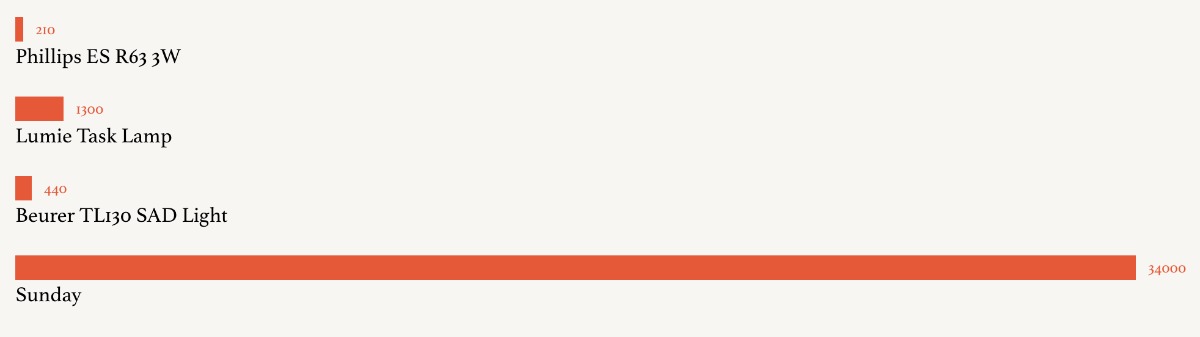
It's the best way to get the benefits of the sun, without the sun.
Plus, apparently, 1 in 3 UK residents get SAD (seasonal affective disorder) in winter. Bright light therapy has been consistently shown to treat it.
Inner Scene skylights also look elite.
🍏 Underrated way to improve sleep quality

New research suggests the more diverse our gut microbiome, the better our sleep quality (particularly in women).
But what is a diverse gut microbiome?
Well, a healthy gut typically has 500-1,000 different types of bacteria. And they all play different roles in:
- 🔨 Breaking down food and absorbing nutrients
- 🦠 Protecting against germs
- 🧱 Producing vitamins, short-chain fatty acids, neurotransmitters, amino acids
- 🛡️ Supporting your immune system
Focus on these 3 foods to introduce and feed good bacteria:
- 🥑 Fibre (fruit, veg, beans, seeds, nuts, whole grains)
- 🍦 Fermented (kimchi, sauerkraut, yogurt, kefir, kombucha)
- 🫐 Polyphenol (berries, dark choc, green tea, olive oil, coffee)
You could probably guess, but a diverse gut microbiome gives us far more than just better sleep quality.
That's it!
Have a great weekend 🤙
Matt
📬 Did someone forward this to you? I send an email like this every week. Join free here.
👇 If these emails aren't for you anymore you can unsubscribe below. No stress, they're not for everyone.
 Want more? Check out the Everday Athlete Toolbox and Elite Sleep Audit
The Everyday Athlete Newsletter is not a licensed health service nor a substitute for professional health advice, treatment or assessment. The information shared in this email is general and written for a specific audience. If you’re struggling, please see a healthcare professional.
0 comments