
👋 Hey. Welcome to issue #126 of The Everyday Athlete Newsletter.
Here are my 3 favourite ideas, learns and resources to help you improve your performance this week (4 min read):
😮💨 Identifying a potential cause of insomnia in 2 mins

Insomnia causes can be complex — from mental health to other medical conditions.
But one thing we can easily test for is carbon dioxide (CO2) sensitivity.
It’s a simple breathing test. It takes 2 minutes. And it’s a great indicator of chronic stress levels and our ability to deal with it — which can drive sleepless nights.
See, we breathe in oxygen. And we breathe our carbon dioxide.
But poor breathing mechanics (e.g. posture, mouth breathing) and/or stress (chronic or acute) speed up our breathing.
And when we breathe fast like this, carbon dioxide levels in the body drop.
And if this is happening chronically, we can start to become sensitive to higher levels of carbon dioxide.
Our body senses any increase in CO2 levels as a threat. And we have this negative feedback loop. CO2 sensitivity > stress response > fast breathing > low CO2 levels > drives more CO2 sensitivity.
So, the test…
- Take four deep breaths in and out through your nose
- Take one more inhale (fill your stomach and lungs to the max)
- Start a timer and breathe out slowly through your mouth for as long as you can
Note: This test is just an indicator, not a diagnosis. Age and fitness levels can influence results. Best done when you're feeling pretty chilled out and haven't just exercised.
Results:
- < 20 seconds = poor
- 20-40 seconds = average
- 40-60 seconds = good
- 60 seconds = great
Less than 20 seconds, is a pretty good indicator you're CO2 sensitive.
And by training your ability to deal with increased carbon dioxide levels can break this stress feedback loop, improve your stress resilience and — often — sleep.
How?
Breathing exercises can help (as part of a broader sleep hygiene approach).
Specifically: Box breathing (how-to).
3-4 seconds each side of the box.
Download the free One Deep Breath app. Find the box breathing protocol. 3-5 minutes a day.
When done daily, you can see improvements within a few weeks.
📖 Sweat Science
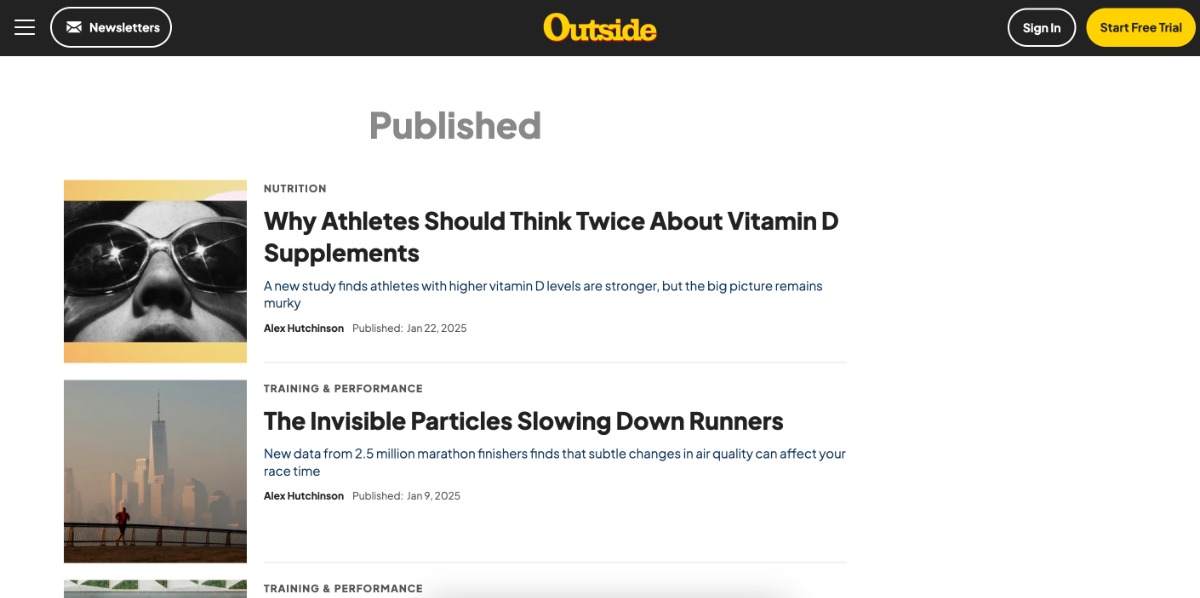
Alex Hutchison is one of my favourite sports science writers.
His fortnightly column — Sweat Science — in Outside magazine is consistently elite.
Some recent crackers:
- Why Even a Little Bit of Air Pollution Slows You Down
- Why Easy Is Better than Hard for Marathon Training
- Olympic Champions Are Wearing This $200 Cooling Headband. Does It Actually Boost Performance?
You can read them here.
🧠 How to crave healthy habits

We can rewire our brains to crave things like exercise and pass on things like junk food.
It’s a quick mental reprogramming. And — once it’s a habit — it’s a powerful behavioural changer.
Because it’s so easy to skip exercise or give into the glistening red wrapper of the king-size kit kat that catches your eye when you go to pay for petrol.
But when we do, we feel sh*t after.
Ragrets.
But in those moments, if we can train our brain to think about how we’ll feel after, it’s a like a magic switch that drives us into taking the action our future self will thank us for.
Here's how it works:
I don’t feel like running. I think about how I’ll feel after that run. Now I want to run.
I feel like cracking those red rock delis open on a wednesday arvo. I think about how I’ll feel after pounding them. Now I don’t want to.
Next time you find yourself tossing up one of these decisions, try think about how you’ll feel after doing it.
Here's the mental program:
[When I consider negative habit] > [think how future self will feel after]
It takes reps. But once it’s a habit, we're back in control of the monkey brain.
That's it!
Have a great weekend 🤙
Matt
📬 Did someone forward this to you? I send an email like this every week. Join free here.
👇 If these emails aren't for you anymore you can unsubscribe below. No stress, they're not for everyone.
 Want more? Check out the Everday Athlete Toolbox and Elite Sleep Audit
The Everyday Athlete Newsletter is not a licensed health service nor a substitute for professional health advice, treatment or assessment. The information shared in this email is general and written for a specific audience. If you’re struggling, please see a healthcare professional.
0 comments